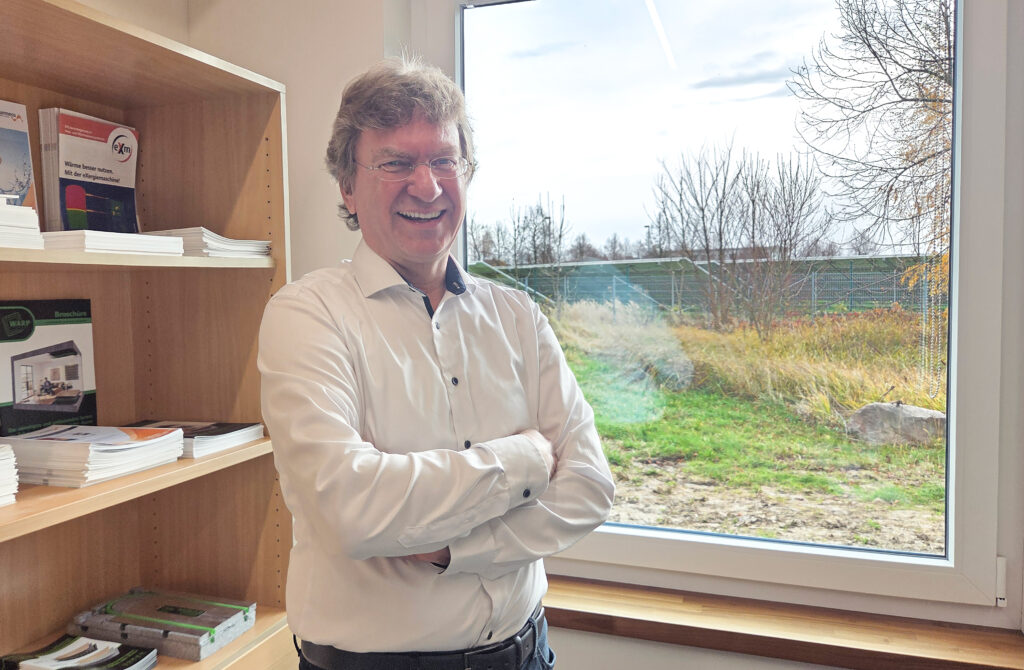
Wolfram Friedel shows how integrated energy solutions can make buildings virtually self-sufficient while combining efficiency, comfort and sustainability.
Modern heating and cooling systems are essential in times of rising energy prices and increasing sustainability requirements.
more in demand than ever. Friedel Modern Heating relies on the combination of PVT collectors, heat pump, eXergiemaschine
and electricity storage - a system that generates electricity and heat simultaneously and redefines efficiency. The approach is aimed at building owners, planners and companies who want to operate independently, energy-efficiently and cost-effectively in the long term.
Mr. Friedel, you stand for holistic energy concepts. How has your approach developed?
I already recognized this during my training as an environmental and process engineer: It's not enough to simply
It's not just a matter of optimizing the system, the whole system has to be right. I realized that no single manufacturer can supply all the components needed to build truly sustainable solutions. That's why today we combine technologies from different partners to create a coherent overall concept that is tailored to the needs of each project.
What distinguishes your solution from conventional heating systems?
We want simple and economical solutions that work in the long term. The right combination is crucial. PVT collectors generate electricity and heat at the same time, which saves space and material costs. It is important to select the right collector for the property in question. Together with our industry partner varmeco, we have carried out extensive analyses to achieve the ideal balance of electricity and heat generation. The result is a system that is efficient, durable and low-maintenance.
The eXergiemaschine (eXm) is the heart of your system. What makes it so efficient?
The eXm is a high-temperature heat pump that can absorb heat up to 60 degrees. It works precisely where conventional heat pumps lose efficiency. In a system with eXm, the main heat pump can operate at optimum efficiency and the eXm raises the temperature specifically to the level required for hot water preparation or for conventional radiators. This saves energy and extends the service life. The interaction between the main heat pump and eXm ensures particularly even operation and a stable heat supply, even at sub-zero temperatures.
How does the system perform in practice?
The advantages are particularly evident in large buildings, for example apartment blocks or the buildings constructed by Krabbes &
Krabbes Projektentwicklung's residential and care facilities. Air heat pumps rarely achieve the required 60 degree hot water temperature in winter, the eXm does this effortlessly and saves several thousand euros in energy costs per year. The system has also proven itself in the district heating sector. The eXm can lower the return flow to the district heating network. District heating customers can thus comply with the conditions of use and district heating providers can connect more users to the existing network. In Jena, the University Hospital is already successfully using this technology, and further projects are in the planning stage.
How economical is such an investment?
Depending on the application, the eXm pays for itself in five to ten years, sometimes sooner. In addition, the main heat pump benefits from lower loads and a longer service life. These factors make the system attractive in the long term. There are also subsidy programs for energy-efficient building technology that make it easier to get started. This creates a cycle of efficiency, sustainability and cost-effectiveness that benefits owners and users alike.
What developments do you expect for the future of heating?
A large part of the energy supply will be based on electricity in the future. Intelligent electricity storage, dynamic tariffs and AI-supported control will become standard. In combination with photovoltaics and electromobility, a sustainable, efficient and economical energy future is emerging. My aim is to continue to network such systems and design buildings in such a way that they can cover their energy requirements intelligently. And this is no longer a vision, but a reality!
Contact our Area representative and find out how to optimize your system.