Tested: How well does the heat pump heat pump heating in a half-timbered house?
Energy-saving potential in listed buildings exhausted
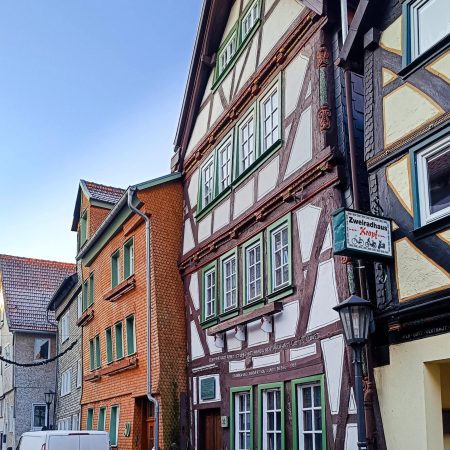
Can a listed half-timbered house from the 17th century be heated with a heat pump?
How big is the savings potential?
Walter Diebel, Regional Sales Manager at varmeco GmbH & Co. KG, answered these questions in a self-experiment.
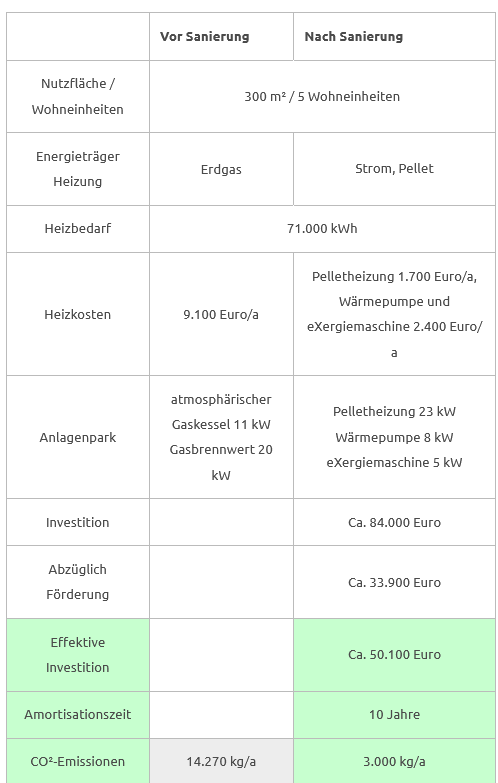
Anticipated: Today, the Diebel family heats their two half-timbered houses in Alsfeld around 40% more cheaply than before with natural gas heating.
Before and after comparison
Monument protection limits passive insulation measures
Before renovating the heating technology, Diebel had already taken passive energy-saving measures - as long as this was permitted by the preservation order. On the inside, for example, clay plaster, wood fiber boards or thermal insulation plaster ensure lower heat loss, while on the outside, thermal insulation was only allowed to be applied under the wood and slate shingles. But even with this, the heat transfer values of the houses are a far cry from those of today's buildings. As some of the ceilings of the buildings, which offer around 300 m² of living space, are low, underfloor heating is not feasible; ceiling heating would not be practical due to the beam construction. „This meant we had to stick with traditional radiators, which require a higher flow temperature to cover the heat demand in winter,“ explains Diebel.
Climate-neutral heating with electricity and pellets instead of natural gas
Not exactly the best conditions for the use of heating heat pumps, as they operate with poor efficiency at high flow temperatures.
However, TGA specialist planner Diebel loves challenges, and when his employer eXergiemaschine he ventured into the renovation project. „We wanted to switch to clean heating technology,“ he reports.
Electricity or wood should replace natural gas as the energy source. „The eXergiemaschine also makes it possible to plan an efficient heating system for our timber-framed houses that uses a heat pump as the main source.“
The eXergiemaschine provides the temperature boost
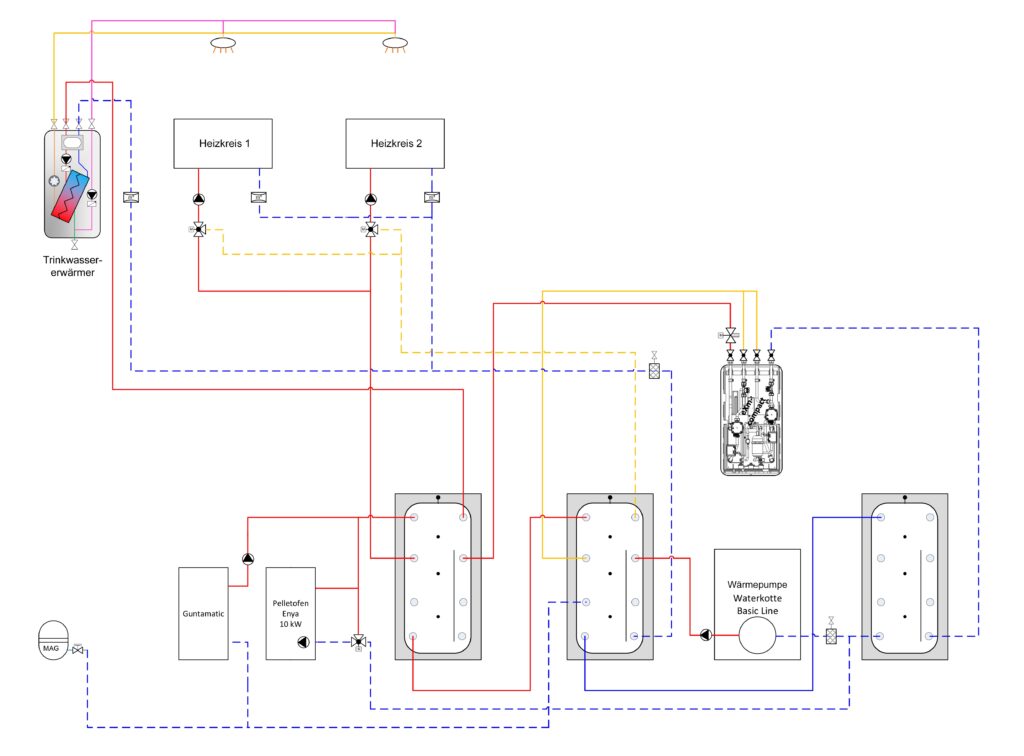
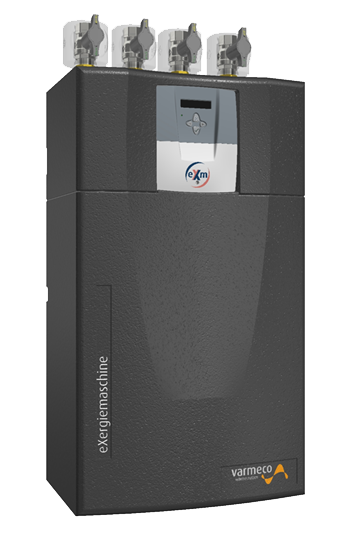
The eXergiemaschine is a special water-to-water heat pump developed by Diebel's employer varmeco and its Swiss partner BMS-Energietechnik, which is designed for higher source temperatures of 30 °C and above. It therefore does not replace the heating heat pump, but can usefully supplement it.
The heat pump can work in its optimum operating range and only needs to supply 35 or 40 °C, while the eXergiemaschine provides a further temperature boost of up to 65 °C. This is hot enough for high flow temperatures in the heating circuit or for hygienic hot water preparation. „Although two devices - heat pump and eXergiemaschine - are then working, they require significantly less power in total than a heat pump alone, which has to reach high target temperatures,“ explains Diebel.
Space (for storage heaters) even in the smallest cellar
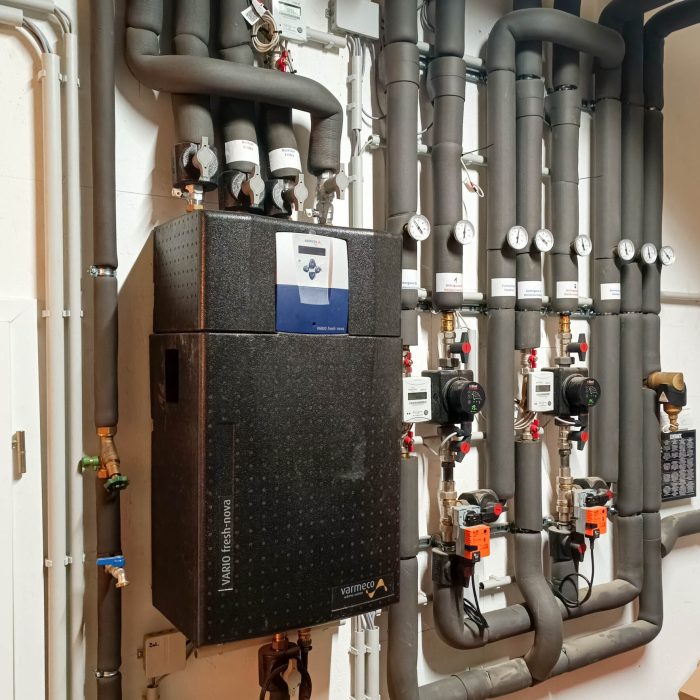
For the operation of the eXergiemaschine a heat accumulator is required, as is used in newer heating systems anyway.
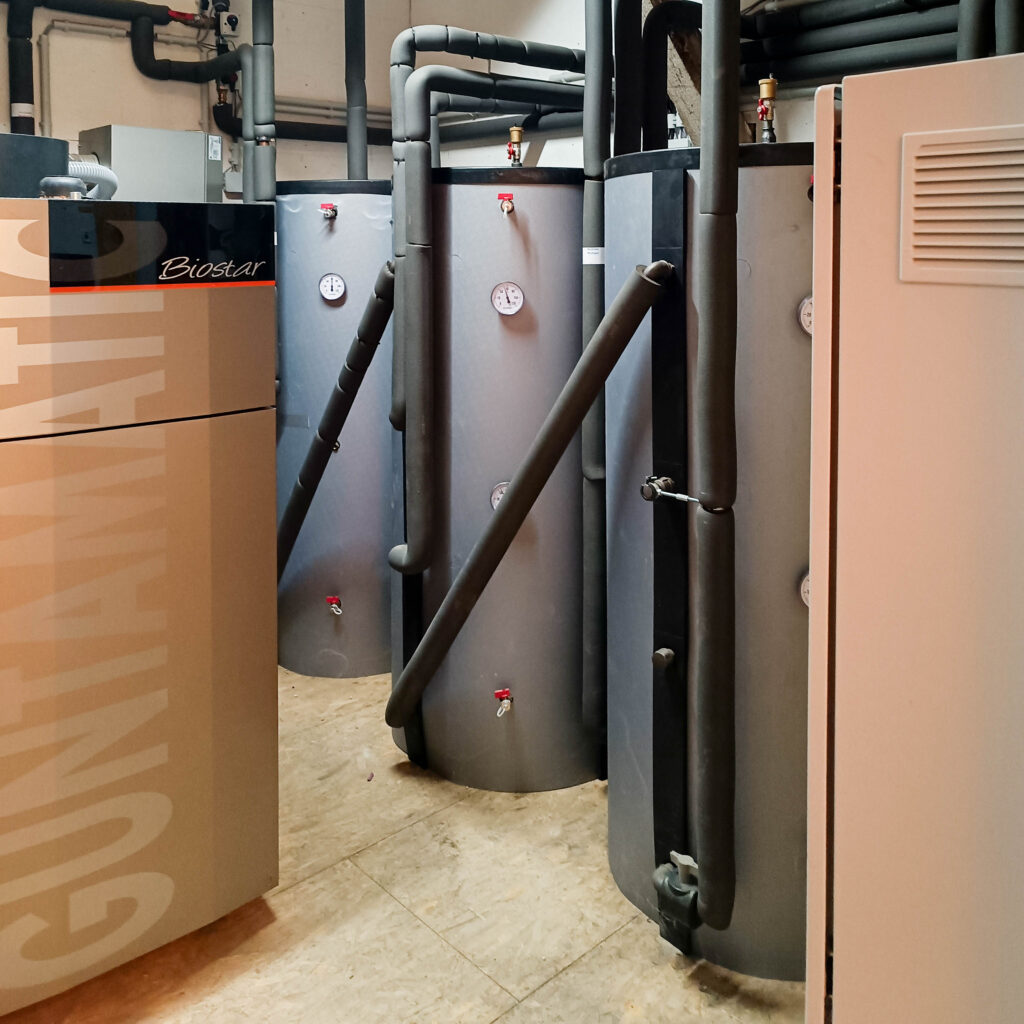
In the Diebel family's case, however, it was not so easy to install: „Low ceilings and small doors prevented us from installing a storage unit with the necessary volume - so we had three smaller ones installed instead,“ says Diebel.
Each cylinder is assigned its own temperature range (cool, warm, hot). The heating circuits of the two buildings and the hydraulic instantaneous water heater for DHW heating access the hot cylinder, in the upper section of which a temperature of around 65 °C is provided.
Pellet boilers for cold winter days
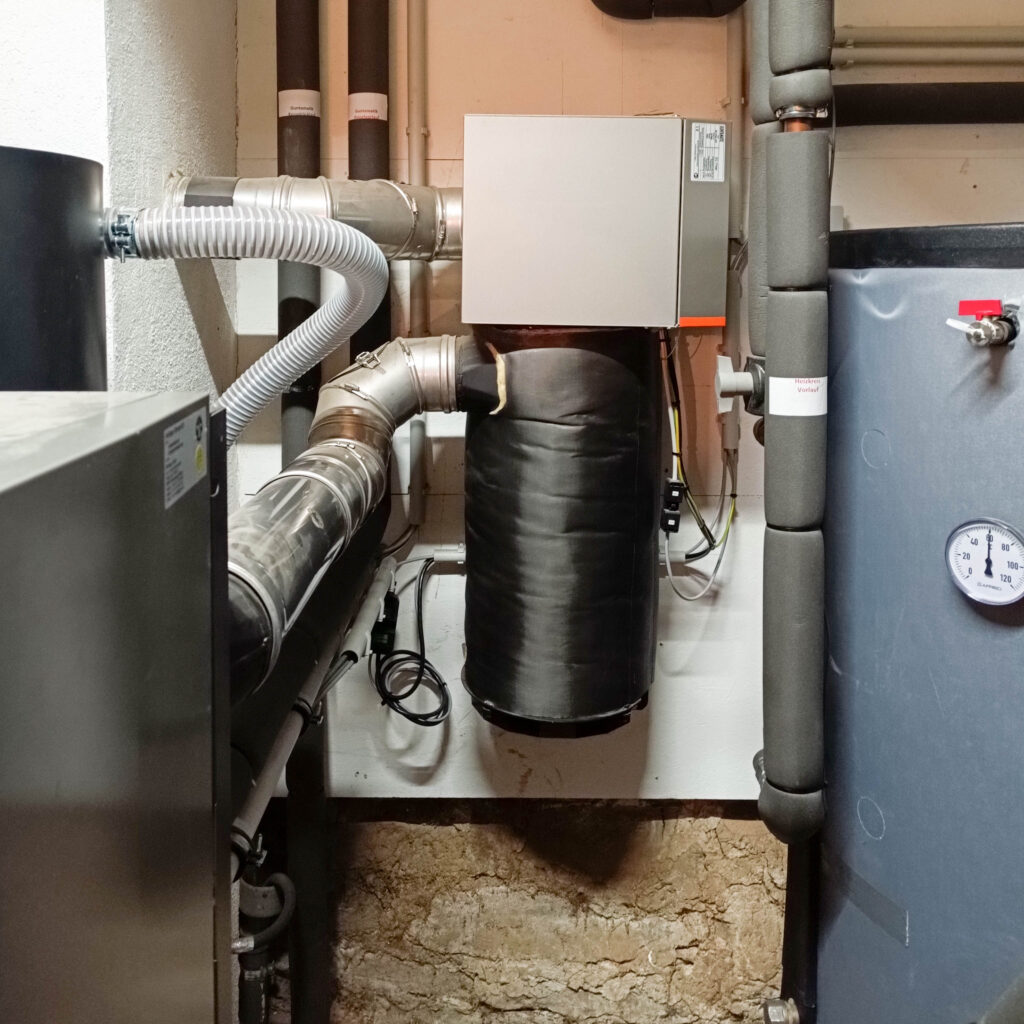
Down to an outside temperature of approx. 5 °C, the new air-to-water heat pump and the eXergiemaschine sufficient heat to operate the heating and hot water system. At temperatures around and below freezing, a pellet heating system (with fine dust filter) supports the heating system.
Higher-level controller creates transparency
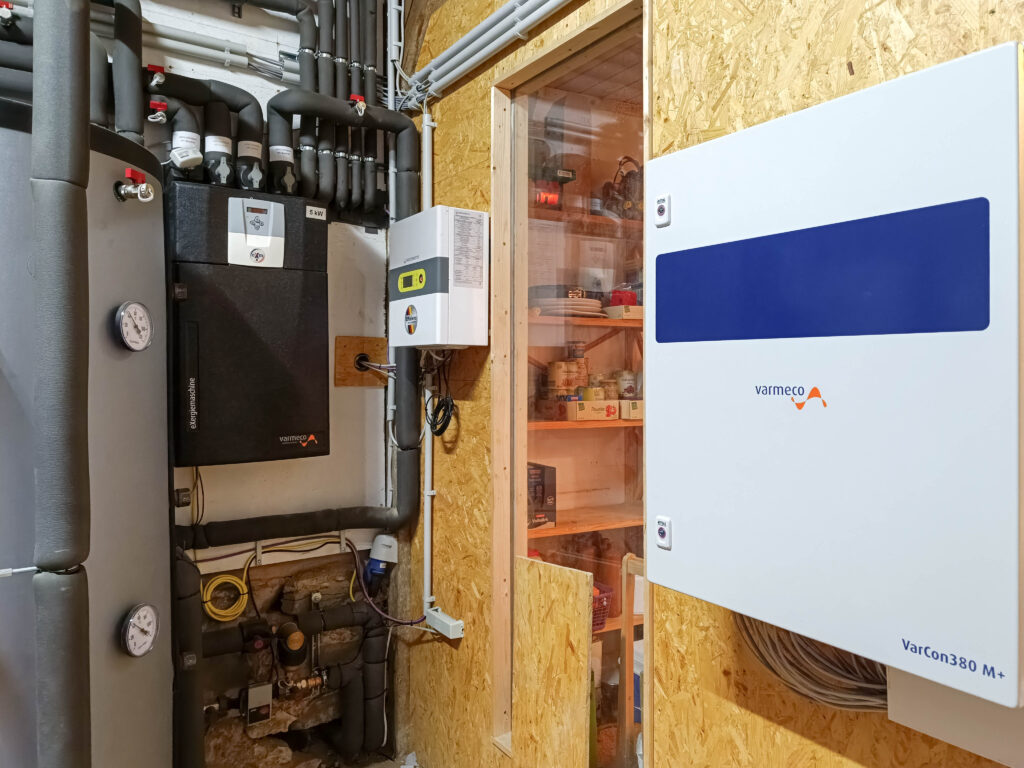
The controllers of all heat sources operate temperature-controlled and autonomously. Nevertheless, Diebel has provided the system with higher-level electronics - the system controller VarCon380 from varmeco. „I can see the operating status of the sources and the heat flows [the respective temperatures in the flow and return] or fault messages on the controller,“ says the homeowner, explaining the advantage of the VarCon380.
„All key operating information is displayed in a clear interface, which I can view on my computer via Ethernet or the Internet.“ The system controller also made it possible to optimize the heating circuit control for the two buildings in order to save even more energy.
Around 40 percent lower energy costs
Diebel is satisfied with the result of his renovation project: „We are now not only heating CO2-neutrally, but also saving on operating costs.
Instead of spending around 7,000 euros a year on natural gas, we now spend around 4,200 euros on electricity and pellets for heating. Energy costs are therefore 40 percent lower.
“The investment in the new technology therefore pays off in the long term. „The amortization period is longer than for many other properties,“ admits Diebel.
„But our building proves that even buildings that are around 400 years old can be equipped with a modern central heating system and operated economically.“
How the eXergiemaschine works
Around 40 percent lower energy costs
The eXergiemaschine is available in the 3- and 5-kW version is available as a compact wall-mounted appliance (see image) and in the output classes 5 to 40 kW heat output as a floor-standing appliance. An even larger eXergiemaschine for hospitals, apartment blocks or commercial use, for example, is currently under development.
What our customers say
Further references on refurbishment projects
Get personal advice now!
Get a real head start!
Let our experts advise you personally and benefit from our experience!