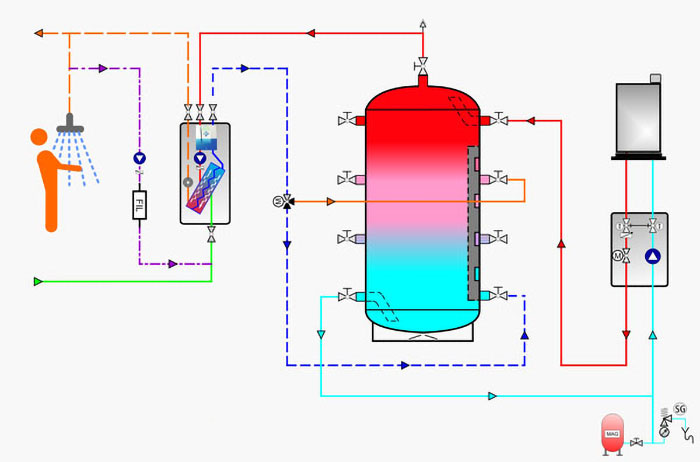
- Hygienic operating principle (instantaneous water heater)
- Demand-oriented and energy-efficient provision
- Exergy-optimized wiring for maximum energy efficiency
- Same temperature for small and large dispensing volumes
- Optional circulation mode for maximum hot water convenience
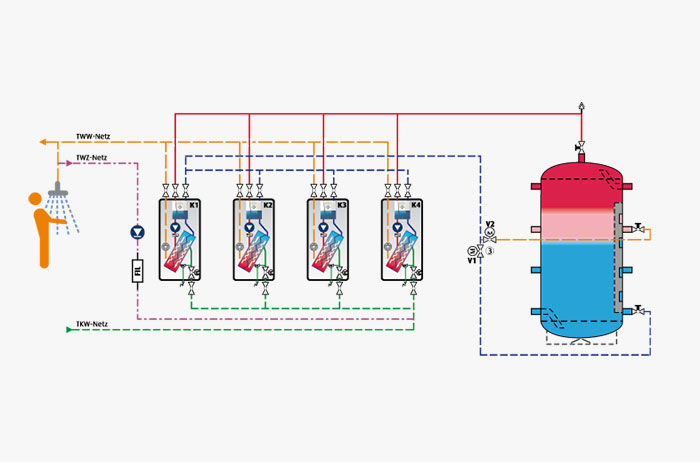
- Cascade connection for large, fluctuating demands
Hygienic heating of fresh drinking water
Are you aware of the danger posed by legionella and looking for a safe, hygienic solution for heating water? You have found the right solution. Because varmeco fresh water technology heats water using the continuous flow principle. This means that the water is not stored preheated, but only heated when it is needed. This means that legionella bacteria have no chance of multiplying. A reliable, hygienic principle that can be used for both small and large quantities.
You are currently seeing a placeholder content of YouTube. To access the actual content, click on the button below. Please note that data will be passed on to third-party providers.
More informationAccurate to the degree for small and large loads
Whether residential, commercial or sports facilities - we offer solutions with fresh water technology (fresh water station) for all properties, making showering, washing or cooking more hygienic and convenient at the same time. Our controllers ensure this with demand-based and energy-efficient heat input. If little hot water is tapped, only a small amount of heat is used. If a lot of hot water is required, the controller increases the heat output and can therefore cope with even large quantities. As a result, the hot water always reaches the tap at a constant temperature - not too hot, not too cold. This makes showering, for example, a pleasant experience.
Hot water circulation: efficient and hygienic
Where immediate availability of hot water is desired or required according to the rules of technology, our exergy-optimized fresh water heater cascades offer the ideal compromise between convenience and efficiency. With them, the circulating hot water is always kept at a sufficiently high temperature level to effectively prevent the proliferation of legionella bacteria. When domestic hot water is required, low heating return temperatures are generated. This system takes into account both comfort and energy efficiency.
How the fresh water technology works
Flow process
The fresh water heaters draw heat from a heat storage tank (heating buffer tank). If hot drinking water is tapped at a tapping point (e.g. shower or washbasin), a pump is activated which pumps hot water from the buffer tank to a stainless steel plate heat exchanger. The heat is then transferred to fresh, cool drinking water. The continuous flow principle ensures maximum hygiene.
You are currently seeing a placeholder content of YouTube. To access the actual content, click on the button below. Please note that data will be passed on to third-party providers.
More informationAdaptive controller
The amount of heat provided by the cylinder depends on the respective hot water withdrawal and is regulated by the feed pump.
Not only that: the controller's neural network is capable of learning and continuously processes information about consumption behavior. As a result, the controller adapts to the operating conditions.
You are currently seeing a placeholder content of YouTube. To access the actual content, click on the button below. Please note that data will be passed on to third-party providers.
More informationEnergy-saving circulation mode
In hot water systems with circulation, the integrated circulation pump can be controlled both time-dependent and temperature-dependent. If a preset temperature is reached at the circulation return line sensor, the circulation pump switches off. This saves pump power and minimizes heat loss.
What do our latest generation devices look like?
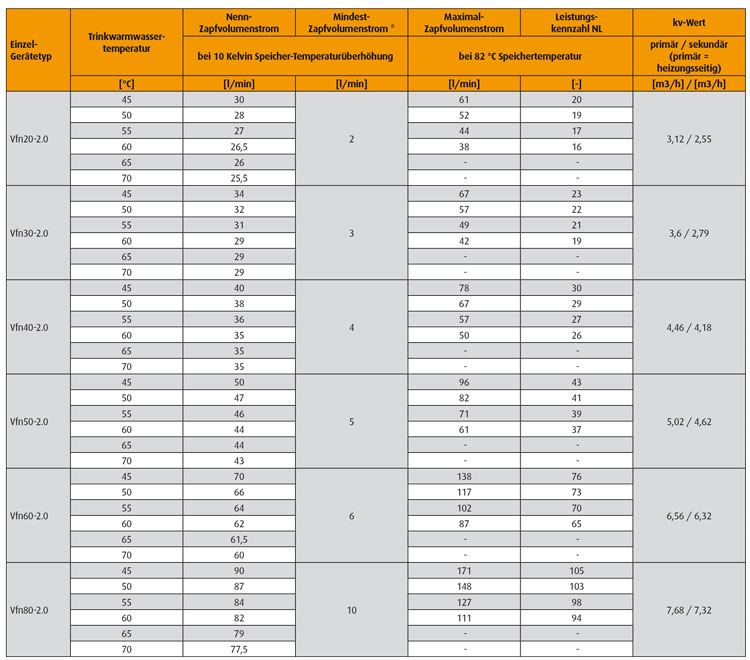
For orientation: For a comfortable shower bath you need about 8 l/min at 45 °C.
The pouring capacity depends mainly on the size of the heat exchanger and the storage tank temperature. We have created precise tables and diagrams in which all influencing variables have been taken into account.
The table below shows that maximum filling capacities of 40 to 84 l/min are possible with individual appliances. If several appliances are combined, i.e. cascaded, up to 316 l/min can be tapped in a cascade of 4, for example.

A typical diagram for a fresh water system with a single appliance is shown above. For higher output requirements, the appliances are cascaded in a Tichelmann circuit, shown below.
Characteristic: the storage tank is a buffer tank and not a drinking water tank!
A selection from the variety of conceivable centralized or decentralized system schemes is provided by the Reference documentation. There is a suitable solution for every requirement.
Both systems prepare domestic hot water using the flow-through principle. The designation Fresh water station However, the term is used very generally throughout the industry and covers a wide variety of technical designs. A Fresh water heater on the other hand, clearly describes an appliance that heats drinking water hygienically, energy-efficiently and without storage when tapped. The term Fresh water heater it therefore becomes clear what technology you are getting and what performance data is behind it.
The decisive factors are a hygienic design, an optimally matched heat exchanger, reliable control technology and a sufficient volume flow. Only when hydraulics, temperature control and heat transfer work together efficiently can domestic hot water preparation remain stable, low-energy and convenient in the long term.
A fresh water module is a compact component for heating drinking water using the flow-through method. It contains all the central components - such as the heat exchanger, control unit and valves - in one device. In more complex systems, several modules can be combined or integrated into existing systems in order to specifically expand or adapt the hot water output.
Fresh water technology impresses with its hygienic instantaneous water heater principle, in which drinking water is only heated at the moment of use. This means that fresh hot water is available at all times - safely, cleanly and reliably.
The supply is demand-driven and energy-efficient. Exergy-optimized wiring ensures that the energy used is used optimally and maximum efficiency is achieved.
At the same time, the fresh water technology offers maximum convenience: the water temperature remains constant - regardless of whether small or large tap quantities are required. As an option, circulation mode enables hot water to be available immediately, while a cascade circuit reliably covers even large and highly fluctuating demands.